

Background:
Acute injury to extremities is a common surgical challenge. Road traffic accidents (RTA) are the most common etiology and are usually associated with soft tissue injuries and fracture patterns. Other injuries include gunshots, firework and burns. Negative-pressure wound therapy (NPWT), also known as vacuum-assisted closure (VAC), has revolutionized the wound care protocols. The use of NPWT has become quite common in chronic wounds, but only was reported in very few literatures as an immediate management in acute injuries.
Objectives: to evaluate early use of NPWT compared to conventional dressings in the management of acute injuries in upper and lower limbs with tissue loss and/or open fracture.
Methods:
The study included 47 consecutive patients divided into 2 groups: the first group included patients who received NPWT after initial surgical debridement and fracture fixation if required. This group included 27 patients with age ranged from 3 to 73 years with average 38 years. The second group received conventional wound dressing and included 20 patients whose ages ranged from 15 to 46 with an average of 30.5 years.
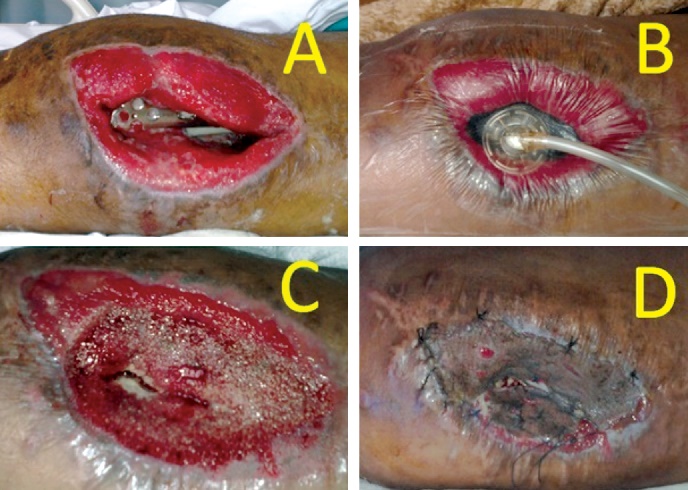
Results: NPWT reduced wound size of 1.7 times more compared to conventional dressings. It also reduced the average healing time to 18.5 days in the NPWT group compared to 28 days in conventional dressing group.
Conclusion: NPWT is a safe, simple and cost-effective technique in the management of acute limb injuries.