

Objective
Dysplasia of lateral semicircular canal (LSCC) is a common inner ear anomaly that may exist
in patients with sensorineural hearing loss (SNHL). The diagnosis of subtle anomaly is limited
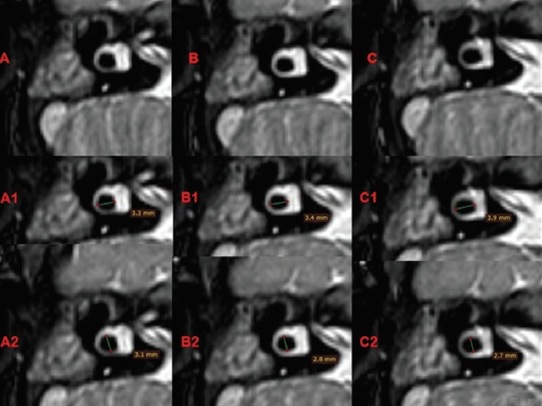
when depending on visual inspection alone to evaluate images. Our purpose is to prove that
routine measurement of the bone island of LSCC can avoid missing subtle anomaly and to
prove that MRI is a valuable tool in diagnosis.
Patients and methods
This is a retrospective study performed on 67 patients with severe to profound SNHL and on
12 patients with tinnitus. Patients were classified into the control group (46 ears of 34 patients),
which had normal MRI findings by visual inspection (24 ears of the 12 patients with tinnitus
and 22 normal ears of 22 patients with unilateral SNHL), and the SNHL group (116 ears of
67 patients), in whom inner ear structures were apparently normal in MRI. Patients with isolated
vestibular aqueduct (VA) dilatation and patients with Mondini deformity were included in this
group. We measured the transverse and the anteroposterior (AP) diameter of the LSCC bone
island in two to three contiguous axial images. The width of VA at its midpoint and at its distal
end was also measured. SPSS, 16.0, for windows, standardized Student’s t‑test and Pearson’s
correlation coefficient were used for statistical analysis.
Results
There was no statistical difference in the bone island width or AP diameter in correlation to
the age (P > 0.05). In the SNHL group, the width of the bone island was less than 2.8 mm in
18 (15.5%) ears, whereas the AP diameter was less than 2.8 mm in 21 (18.1%) ears. The bone
island width and AP diameter tend to be smaller in patients with dilated VA than in patients
with normal VA (P < 0.001). Significant negative correlation was found between the VA width
and the bone island width (r = −0.41) and the bone island AP diameter (r = −0.42).
Conclusion
Developing normative radiological measurements by each institute and routine measurement
of the bone island of LSCC are essential to avoid missing subtle anomalies by visual inspection
alone.