
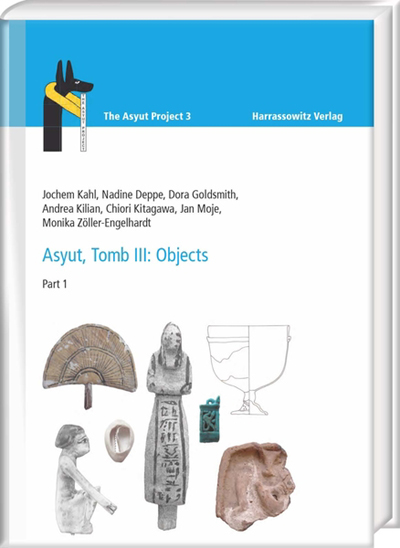
Since 2003, the German-Egyptian "Asyut Project" works on the Gebel Asyut al-gharbi, the burial mound of the central Egyptian city of Assiut. One of the graves examined is that of the nomarch Iti-ibi, who led the fortunes of the city around 2040 BC. His tomb is one of the largest of the first interim period in Egypt. It was repeatedly reused, looted or used by early excavators as a depot. Despite or perhaps because of this unfortunate story, the tomb was rich in finds from the first Interimediate Period to the early New Kingdom, of which a first part is now presented: amulets, glass, wooden models, molluscs, clay candles and shabtis. For the first time, these object groups provide a systematic insight into the regionally specific characteristics of assiutic culture.
Kahl, N. Deppe, D. Goldsmith, A. Kilian, J. Moje, M. Zöller-Engelhardt, Asyut, Tomb III: Objects. Part 1, The Asyut Project 3, Edited by Jochem Kahl, Ursula Verhoeven and Mahmoud El-Khadragy, Harrassowitz Verlag, Wiesbaden, 2016.