

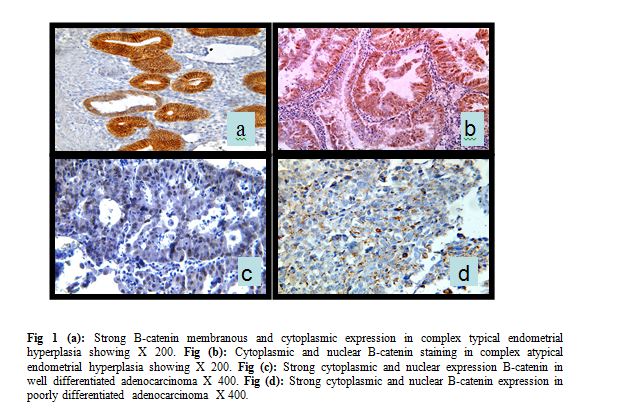
Background: Endometrial carcinoma is one of the most common malignancies of female genital tract. Well differentiated endometrioid carcinoma is histologically similar to complex atypical endometrial hyperplasia and sometimes it is difficult to differentiate between them. We hypothesis that expression of the oncogene B-Catenin may vary in different endometrial lesions and the difference in its expression may be of value to differentiate well differentiated endometrioid carcinoma from complex atypical endometrial hyperplasia. Methods: Immunohistochemical evaluation of B-Catenin was performed on 100 specimens including; 8 proliferative endometrium, 10 secretory endometrium, 10 simple endometrial hyperplasia, 10 complex typical endometrial hyperplasia, 30 complex atypical endometrial hyperplasia and 32 endometrioid adenocarcinoma. Immunostaining of cells was analyzed by arbitrary semiquantitative methods according to both slide's staining area and intensity of color reaction. Results: B-Catenin is expressed in the membrane and the cytoplasm of 100% of proliferative endometrium, 100% of secretory endometrium, 100% of simple endometrial hyperplasia, 100% of complex typical hyperplasia, (60%) of complex atypical hyperplasia and 81.25% of endometrioid adenocarcinoma. Nuclear staining appear in 33.3% of complex atypical hyperplasia and 37.5% of endometrioid adenocarcinoma; 83.3% and 16.7% of positive nuclear staining cases were well differentiated and poorly differentiated adenocarcinoma respectively. There was significant difference in B-Catenin expression between complex atypical hyperplasia and endometrioid carcinoma, but the difference in nuclear B-Catenin between endometrioid carcinoma and complex atypical hyperplasia was insignificant. Conclusion: B-Catenin expression varies in different endometrial lesions. Nuclear expression appears only in atypical endometrial hyperplasia and endometrial adenocarcinoma. B-Catenin could be of value to differentiate complex atypical endometrial hyperplasia from endometrioid adenocarcinoma, but nuclear B-Catenin is of no value to differentiate between both lesions