

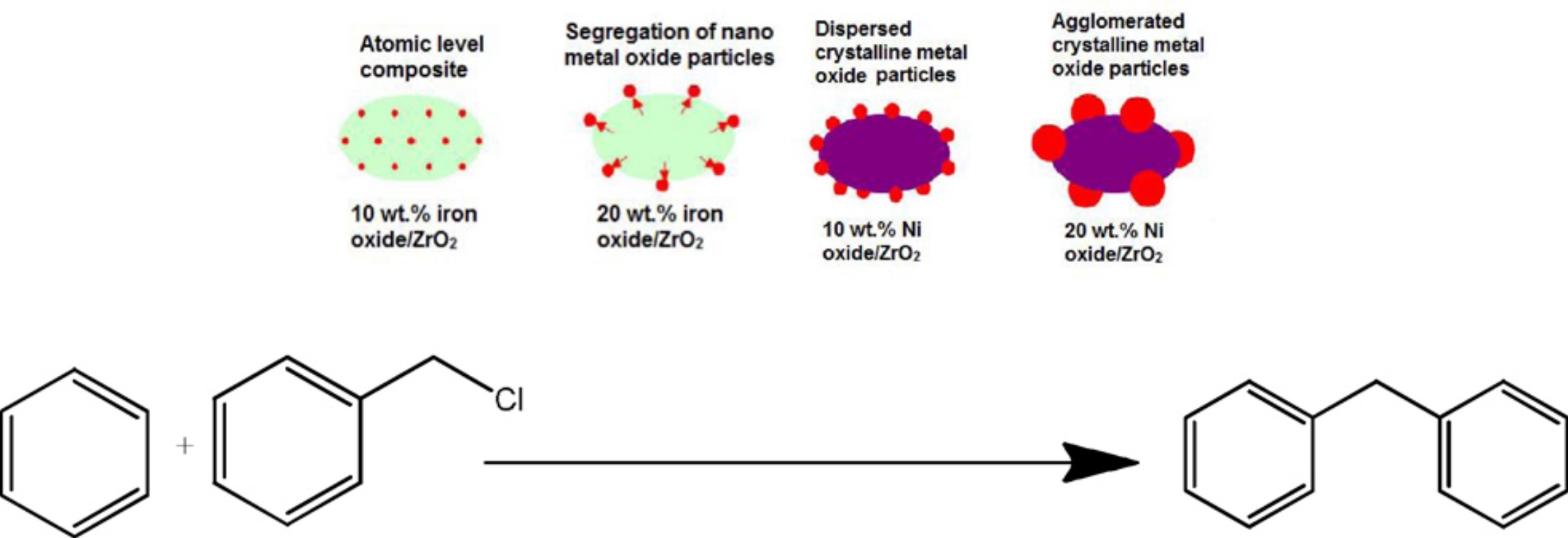
Nanocrystalline Fe2O3and NiO mesoporous ZrO2supported catalysts were prepared and thermallytreated at 500◦C. The efficacy of catalysts for catalyzing the benzylation of benzene using benzyl chloridewas studied. The mesoporous ZrO2alone showed only benzyl chloride conversion of 44% after a reactiontime of 600 min at 75◦C. An increase in the conversion of benzyl chloride to 49% was observed afterloading 10 wt% of NiO on ZrO2.The conversion was further increased to 58% with the increase of NiOloading to 20 wt%. However, a drastic increase of conversion was observed after loading 10 wt% Fe2O3onZrO2, the conversion reached to 78% under identical reaction conditions. The increase of Fe2O3loading to20 wt% led to a significant increase in conversion of benzyl chloride to 91%. The characterization resultsshowed that ZrO2support is mesoporous comprising monoclinic and tetragonal phases. The loading ofthe NiO or Fe2O3led to phase transformation of ZrO2into cubic phase. Diffraction peaks due to Fe2O3werenot observed; in contrast, the presence of segregated NiO phase was observed in case of NiO supportedZrO2samples. The mesoporous ZrO2support maintained the stability of catalytically active Fe2O3speciesafter six reaction cycles. The enhanced catalytic activity of this catalyst is attributed to the presence of agreater degree of dispersion of Fe2O3over ZrO2, higher redox potential and a greater degree of accessiblesurface Lewis acid sites.