

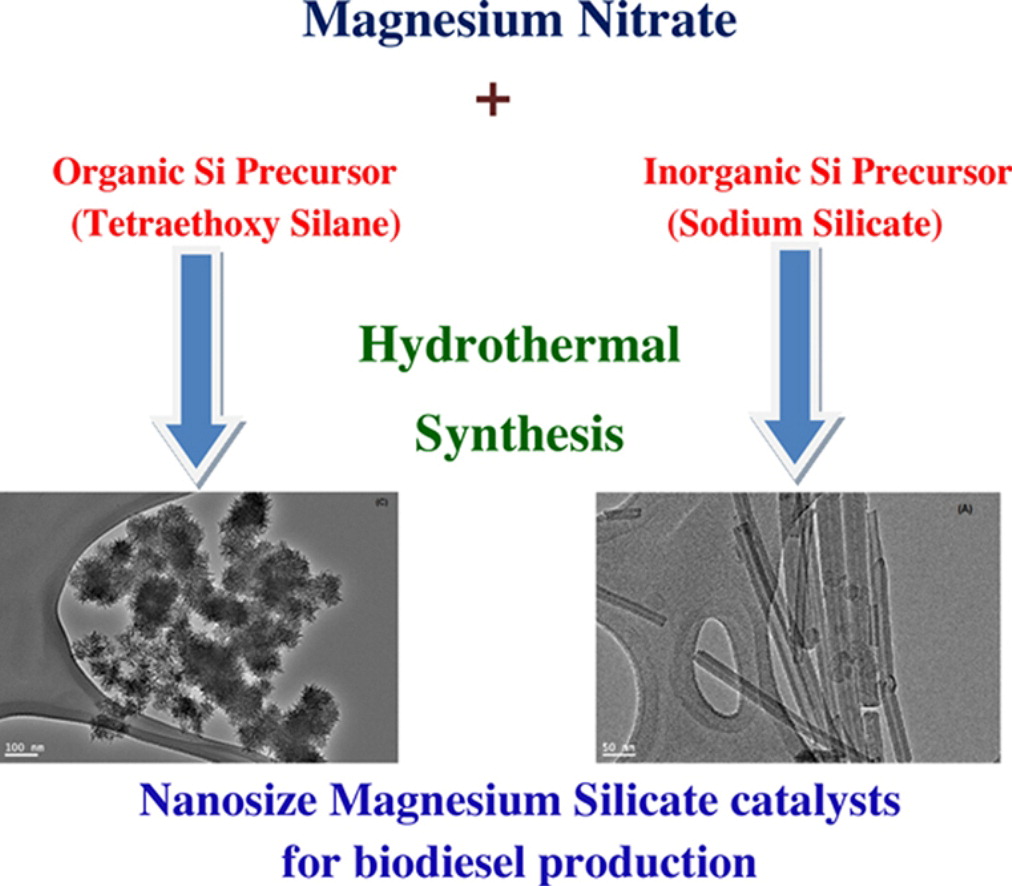
Two Si precursors, inorganic (sodium silicate) and organic (tetraethoxy silane), were used to synthe-size magnesium silicate (MgSil) nanomaterials. The effect exerted by the nature of Si precursors on themorphology and structural properties of the samples was studied by chemical analyses, X-ray diffrac-tion, HRTEM, FTIR spectroscopy, XPS, N2adsorption, solid-state NMR spectroscopy and TPD of CO2 and NH3 techniques. The characterization results show that MgSil-org sample possessed hollow nanosphereswhich are composed of small platelets and sheets; in contrast, MgSil-inorg sample showed nanotubularstructure due to more alkaline nature of the inorganic Si precursor. Additionally, MgSil-org sample havedifferent textural characteristics, acidic and basic properties. MgSil-org sample have higher surface areas,more uniform mesoporous pores, and more number of acidic and basic sites as well as higher activitiesin transesterification of tributyrin and esterification of palmitic acid with methanol than MgSil-inorgsample. MgSil-org sample is stable and showed excellent reusability for more than five cycles withoutany loss of activity in transesterification and esterification reactions.